What investing in veterinary education delivers for Africa’s health and resilience
published on
04/13/2026
written by

Dr Junaidu Maina
Dr Maina is a veterinarian who has served in various cadres and retired in 2009 as Chief Veterinary Officer and former WOAH Delegate for Nigeria. He is an alumnus of the University of Veterinary Medicine, Budapest, Hungary and has vast experience in animal diseases control, design and management of pastoral production systems.
A well-known saying, “planning and action go hand in hand”, reminds us that beyond good intentions; deliberate, practical steps are essential to achieving meaningful outcomes.
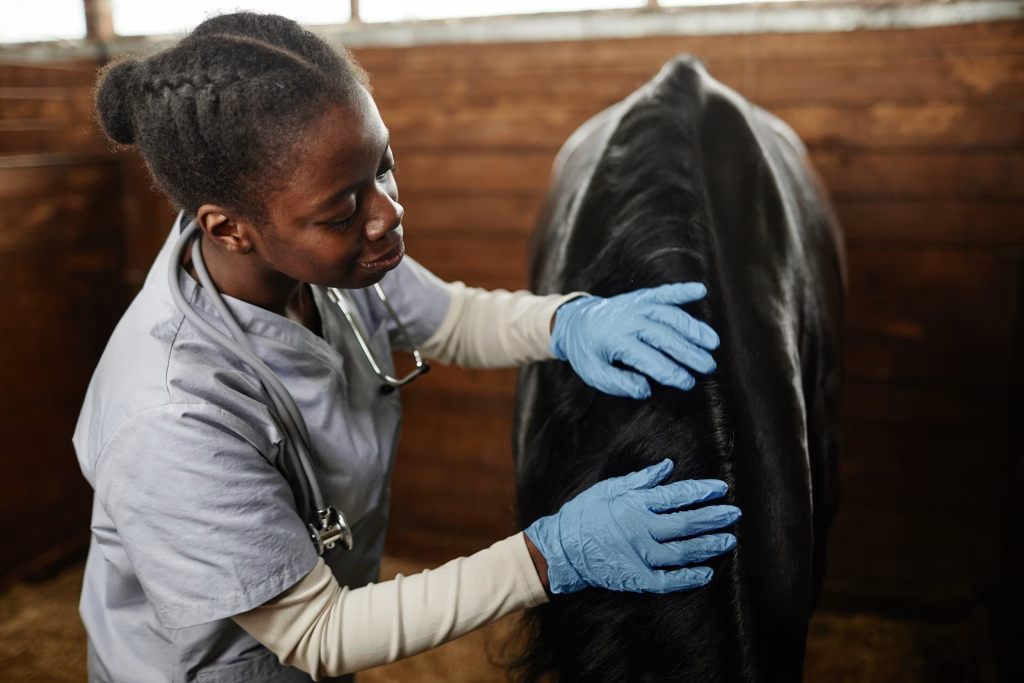
Across geographies, this principle is evident in veterinary education: sustained investment in training, institutional capacity, and human capital produces professionals and systems that strengthen animal health, safeguard public health, and enhance resilience across communities. This is especially relevant in Africa, where zoonotic risks, climate pressures, and food system vulnerabilities demand more robust animal health systems. Long-term investment in veterinary education is central to strengthening veterinary capacity.
As a veterinarian, when I reflect on the practical outcomes of long-term investment in veterinary education in Africa, particularly in Nigeria, one institution stands out for its sustained impact: the Faculty of Veterinary Medicine at Ahmadu Bello University (ABU), Zaria, also known as ABUVET. As a longstanding veterinary faculty, it provides a useful case study for exploring how early and continuous investment can shape national and regional veterinary capacity.
While contexts vary across Africa, the underlying elements such as faculty development, infrastructure investment, and institutional partnerships, remain relevant for veterinary system strengthening more broadly.
Early veterinary medicine faculties in The University of Ibadan (1963) and Ahmadu Bello University – ABUVET (1964) formed the foundation of veterinary education in Nigeria.
ABUVET emerged from an early partnership between Ahmadu Bello University, the United States Agency for International Development (USAID), and Kansas State University (KSU). Investments in foundational academic staff, laboratory equipment and curriculum development anchored veterinary education in Nigeria on strong international standards, while building national leadership capacity.
In 1965, additional support from the Government of the Netherlands, through Utrecht University and Dutch Technical Aid (DITA), helped establish the Department of Parasitology and Entomology, further strengthening research and teaching capacity. These partnerships illustrate a critical lesson: effective collaboration empowers institutions, ensuring that investment produces sustainable impact rather than temporary solutions.
Investing in people, facilities, and institutional culture is key to training veterinarians who can tackle challenges across Africa, from disease outbreaks to food security and public health.
The faculty began graduating veterinarians in 1967, with early cohorts completing pre-clinical training at the University of Ibadan, whose Faculty of Veterinary Medicine was established in 1963. These graduates formed the backbone of Nigeria’s Veterinary Services, contributing to institutions such as National Veterinary Research Institute (NVRI), Veterinary Council of Nigeria (VCN), and the Nigerian Veterinary Medical Association (NVMA).
From federal and state services to research and regulatory agencies, ABUVET graduates have shaped policy, driven innovation, and strengthened Nigeria’s livestock and animal health systems at every level.
Investing in veterinary education isn’t only about training more veterinarians; it’s about enabling professionals to use their skills to make real contributions to institutions, policies, and society.
Today, Nigeria has 16 faculties of veterinary medicine, 11 of which are fully accredited by the Veterinary Council of Nigeria, with others progressing through accreditation.
This structured system ensures harmonised curricula, quality assurance, and professional competence—safeguarding animal health, public health, and the integrity of the profession. With over 12,000 registered veterinarians, most trained locally, the country’s sustained investment in veterinary education is evident.
During my tenure as Chief Veterinary Officer, Nigeria confirmed the first outbreak of High Pathogenicity Avian Influenza (HPAI) in 2006, providing a practical test of national veterinary capacity.
Expertise from nationally and regionally trained veterinarians contributed to response efforts. National response efforts were supported by veterinarians whose training had taken place within Nigeria and the region, alongside international technical assistance.
This combination of expertise enabled coordinated risk assessment, implementation of control measures, and engagement with affected producers and institutions.
Among the international experts deployed by the Food and Agriculture Organization of the United Nations (FAO) to assist Nigeria were two alumni of Ahmadu Bello University—Dr William Amanfu of Ghana and Dr Tesfai Tseggai of Eritrea.
The intervention and presence of regionally trained experts at that critical moment illustrated a key outcome of
long-term investment of veterinary education in Africa.
Although these nationally trained experts had their careers established across borders and global institutions, they chose to serve the very systems that had shaped their professional journey. They later described the experience as deeply fulfilling—an opportunity to give back to the institutions and country that had formed their professional foundation and values. As the African proverb wisely states, “However far a stream flows, it never forgets its source.”
For over sixty years, the case of ABUVET has demonstrated that investing in veterinary education strengthens livestock systems, enhances disease surveillance, advances research, and protects public health.
Although I did not train at ABUVET, my professional experience within Nigeria’s veterinary sector enabled me to absorb elements of the institution’s professional culture through engagement with its graduates in mentorship, collaboration, and shared practice.
This culture of rigor, service, and excellence flows across generations and extends beyond Africa through veterinary academics in the diaspora, who continue to shape faculties and mentor the next generation of young veterinarians globally.
A central truth remains: when Africa trains its own veterinarians to global standards, its capacity to manage animal health risks becomes stronger, more resilient, and more responsive to national needs. Investment does not end at graduation; it extends to institution-building, policy leadership, research advancement, and sustained professional excellence.
How can we further strengthen veterinary education across the continent?
In today’s era of accelerating globalisation, sustained progress demands collective action rather than isolated effort. Regional and continental networks such as The African Union – Interafrican Bureau for Animal Resources (AU-IBAR) can champion a bold and structured collaboration among African veterinary schools; beginning with strong regional platforms and progressively evolving into a coordinated continental and global network.
Investing in veterinary education in Africa goes beyond meeting international benchmarks; it is about confronting Africa’s realities: transhumant pastoralism, diverse agro-ecologies, wildlife-livestock interfaces, the blue economy, emerging diseases, climate change, and the urgent need for stronger regional and continental cooperation, as well as global collaboration.
Done well, investment in veterinary education creates a ripple effect. It strengthens surveillance, food safety, productivity, regulatory systems, and trade. It also supports harmonised standards, cross-border disease control, and coordinated responses to transboundary threats.
Investing in veterinary education is, therefore, an investment in animal health, food security, public health, economic integration, shared prosperity, and Africa’s sustainable future.
The Animal Echo aims to promote individual and collective understanding of animal health and welfare. We bring you insights and opinions from experts across the world. The opinions expressed in The Animal Echo are those of the author (s) and may not necessarily reflect WOAH’s official position.
Continue reading


Receive the latest updates from our Organisation, network, and partners.
This includes Members’ self-declarations, news articles, scientific insights, publications, and more.