How do we build stronger veterinary workforces from the ground up?
published on
10/01/2026
written by
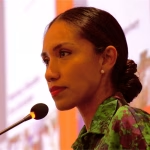
Interviewee: Xyomara Chavez Pacheco
Xyomara is an international veterinarian and public health specialist with more than 10 years of experience. She is currently Project Manager for veterinary workforce development at WOAH, focusing on veterinary education and global capacity building.
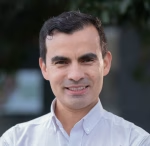
Interviewee: Andrés Bejarano
Andrés is an animal scientist and project management specialist with 14 years at Colombia’s ICA. Also a lecturer committed to animal health education, he promotes an empathetic, trust-based approach to animal health extension, enabling rural families to protect animal health and livelihoods.
Building a more resilient veterinary workforce starts with recognising that animal health systems are built by many people, in many places. Across regions and contexts, supporting these systems requires investment in the people, skills, and networks that enable communities and Veterinary Services to work together effectively. At the core of this conversation are Community Animal Health Workers (CAHWs), a crucial connection between communities and veterinary services. But what does it take to build an inclusive workforce that is effective and sustainable?
This interview brings together two perspectives: Xyomara Chavez Pacheco, Project Manager, Workforce/Animal Health Community Workers, Capacity-Building Department, WOAH, and Andrés Bejarano Bolívar, Coordinator of the Animal Health Extension Programme at the Colombian Agricultural Institute (ICA), the country’s animal health authority.
Together, they both explore how global guidance and field experience can inform one another, shape the future of the veterinary workforce and reveal what it takes to build stronger, more connected animal health systems from the ground up.
If resilient animal health systems are built through connected networks of people and expertise, where do Community Animal Health Workers (CAHWs) fit, and why do they matter?
Xyomara Chavez Pacheco: CAHWs are a crucial part of the wider animal health workforce. They are often the people closest to livestock keepers and communities, particularly in areas where veterinary services may be limited or difficult to reach. Their value is not only in the services they provide, but also in the knowledge and trust they bring.
They understand local contexts, animal-keeping practices and community needs. They can help identify health problems early, support prevention and control activities, and connect communities with veterinary professionals when more specialised support is needed. Strong animal health systems are built through connected networks of people with different skills and responsibilities. CAHWs are part of that network. When their role is clearly defined and supported by appropriate training, supervision, and links to veterinary services, they can make the whole system more accessible, responsive, and resilient.
CAHWs are often described as a bridge between communities and veterinary services. What does that bridge look like in practice?
Xyomara: I think that ‘bridge’ is really about people, communication and trust. CAHWs are often based within the communities they serve, so they understand local realities and can communicate in ways that are familiar and accessible to livestock owners.
In practice, this can mean helping farmers recognise signs of disease, promoting good animal health practices, reporting unusual events and encouraging people to seek professional veterinary support when needed. They can also bring information from the community back to Veterinary Services, helping professionals better understand what is happening on the ground. This connection can be especially important in remote areas, where reaching a veterinarian may take time.
CAHWs do not replace veterinarians. Rather, they complement professional veterinary services by extending the reach of the animal health system. When this relationship works well, information and expertise can move in both directions, creating a stronger connection between communities and the formal veterinary system.
Xyomara Chavez Pacheco, Project Manager, Workforce/Animal Health Community Workers, Capacity-Building Department, WOAH.
Can you share a specific situation where a CAHW’s knowledge, presence or relationship with a community made a real difference to an animal health response?
Andrés Bejarano: Reinforcing a culture of shared responsibility on animal health issues among livestock producers is often a challenge that requires us at the Colombian Agricultural Institute (ICA) to constantly update our methodologies to make a real impact.
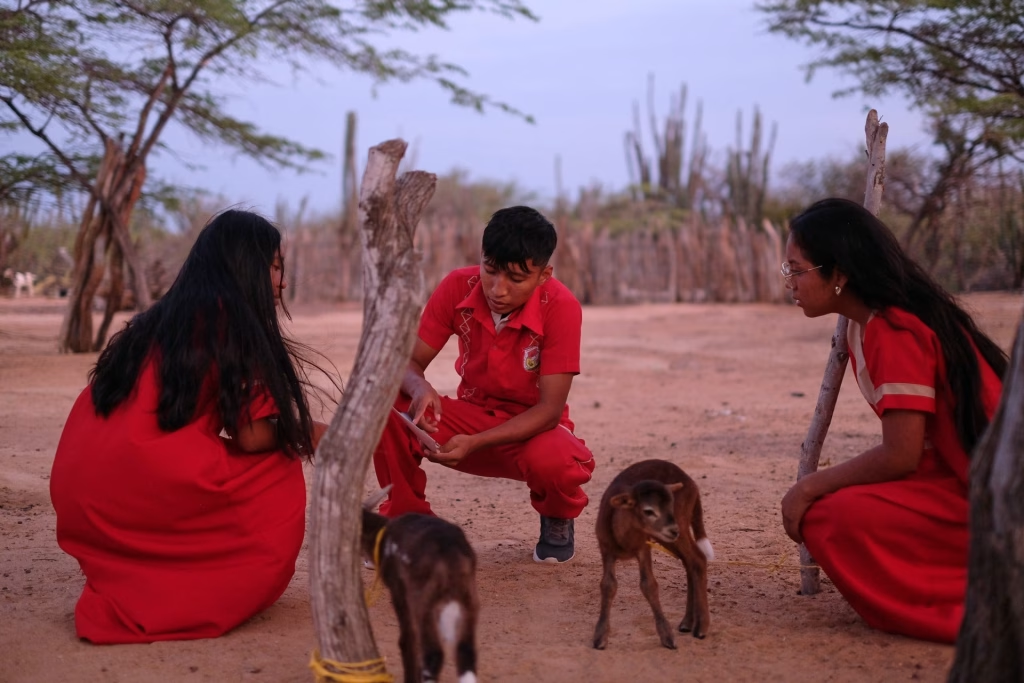
In Colombia, we have a programme called Livestock Epidemiological Sensors, which forms part of the country’s early warning system. Through this programme, farmers and other actors involved in primary production are trained to recognise the clinical signs of diseases under surveillance and voluntarily commit to reporting suspected cases.
These individuals play a vital role in disease reporting by observing signs consistent with these diseases. They can report such signs verbally, online or via WhatsApp, prompting ICA professionals or paraprofessionals to visit the farm, collect samples and investigate. The ‘sensors’ role is voluntary, with participants formally committing to the programme without entering into a contractual relationship with ICA.
One example comes from recent reports of avian influenza outbreaks on backyard farms in Colombia, where low levels of biosecurity can increase the risk of disease transmission resulting from bird migration. In these at-risk areas, extension teams have worked closely with poultry farmers to strengthen three areas: recognising clinical signs, reporting suspected cases promptly to the authorities, and improving production practices to reduce the risk of the disease.
These activities are carried out by the extension team, who support farmers when dealing with emergencies. This has helped strengthen the affected communities’ trust in the Veterinary Services and made it easier for animal health authorities to work with farmers and respond during an outbreak.
WOAH’s guidelines use a competency-based approach rather than prescribing a fixed curriculum. Why is this important, and how can it support the development of CAHWs over time?
Xyomara: A competency-based approach recognises that countries and communities have different needs and resources and even ways of delivering training. Rather than prescribing one curriculum, WOAH’s guidelines define what CAHWs should know and be able to do effectively, allowing countries to adapt training to their context while working towards a common level of competence. This gives countries the flexibility to develop training programmes that reflect their own realities while still working towards a common level of competence. These competencies also provide a foundation for lifelong learning, allowing CAHWs to build on their skills through further training, practical experience, and supervision.
How are these competencies translated into training and practice in Colombia? How do you make sure that what CAHWs learn reflects the needs of the communities they serve?
As WOAH’s competency-based approach recognises, not all communities or their production systems share the same needs.
For this reason, in Colombia, the Veterinary Services’ extension department develops a participatory work plan with producers, identifying their priorities and requirements. Based on this assessment, we, in our role as facilitators and as the animal health authority, design a roadmap aimed at jointly improving their biosecurity and productivity.
The content of these work plans covers topics ranging from the registration of farms with the animal health authority to the implementation of good practices, animal welfare, transport regulations and biosecurity. Throughout this process, we always seek to coordinate with other government bodies (at municipal and departmental level), trade associations and non-governmental organisations (NGOs), amongst other strategic stakeholders.
As global guidance meets contextual realities, what are the opportunities and challenges of translating competencies into practice?
Xyomara: One of the biggest opportunities is that competencies give countries a clear framework while leaving room to develop solutions that fit their own realities. A country can look at its animal health needs, available resources and existing workforce, and then design training and support around what is most relevant. But translating competencies into practice is not always simple. Countries may have different levels of access to education, veterinary services, infrastructure, and resources. There may also be differences in how CAHWs are recognised, supervised and integrated into the wider veterinary workforce. This is why implementation needs to be realistic and supported by strong partnerships. Competencies should not be seen as a checklist, but as a foundation for developing people and systems. The opportunity is to create a more consistent direction globally while allowing countries the flexibility to find solutions that work locally.
What have been some of the biggest challenges in strengthening and integrating the CAHW workforce in Colombia? What has worked, what has been difficult, and what have you learned along the way?
Andrés: The main challenge we have identified is ensuring that the direct line of communication between producers and the animal health authority is sustainable in the long term, rather than relying on short-lived bursts of enthusiasm that fade over time. For this reason, as part of the outreach strategy, the designated liaisons in the priority communities receive between five and six follow-up visits throughout the year. The aim is to ensure continuous support and to implement the previously established work plan. This follow-up consists of visits to farms and risk communication activities, aimed at keeping producers’ health knowledge up to date.
Working with communities is a continuous learning process; each producer and production system requires specific planning, particularly given Colombia’s unique characteristics as a tropical, highly biodiverse and multicultural country.
Andrés Bejarano, Coordinator of the Animal Health Extension Programme, ICA, Colombia.
However, we have identified that printed material is a priority need and fundamental support for all our work. Ensuring its availability has been a challenge, due to both budgetary and logistical factors, compounded by the challenge of ensuring that, once delivered, farmers make the most effective use of it.
Ultimately, what can we learn from CAHWs about building stronger veterinary workforces? How can lessons from building animal health systems from the ground up strengthen the veterinary workforce of the future?
Xyomara: I think that one important lesson from CAHWs (and veterinary paraprofessionals [VPPs]) is that a strong veterinary workforce is not built around veterinarians alone. Animal health systems depend on different people, with different skills, working together, and understanding how their roles connect. CAHWs also show us the importance of building capacity close to communities.
When we invest in people who understand local needs and give them the right skills, support and connections, we can strengthen the system from the ground up. This is particularly relevant when thinking about the veterinary workforce of the future. We need to move beyond thinking only about individual professions and look at the wider workforce and the different roles needed to protect animal health. CAHWs reminds us that workforce development is ultimately about people, relationships, trust and continuous learning. If we build those connections well, we can create animal health systems that are more resilient, inclusive and able to respond to future challenges.
What lessons from Colombia could be useful to other countries thinking about how to strengthen their systems?
Andrés: Although ICA has had its epidemiological sensor programme in place for several years, and the animal health extension strategy was formally established within the Institute approximately three years ago, we remain in a process of continuous improvement and learning. We draw on the experience gained in the field by ICA staff throughout the country. Some key lessons we’ve learnt are:
- Training producers within a community in animal health matters, with two fundamental objectives: to encourage them to put down roots in their local area and to promote the sharing of acquired knowledge with other residents in their region.
- Drawing up work plans by mutual agreement between the animal health authority and producers, with the aim of listening to their needs and effectively addressing their specific circumstances.
- Providing educational and printed materials that facilitate learning, regardless of the population’s level of education, which tends to vary greatly in rural areas. Providing ongoing support helps ensure an institutional presence and strengthen communities’ trust in the animal health authority.
- Strategically selecting epidemiological sentinels, prioritising people from the same region or community who demonstrate leadership and a willingness to embrace change; individuals who motivate their peers and act voluntarily as the health authority’s extended arm in the field.
Animal health systems may be built through policies, programmes and services, yet they also depend on people to make those connections work in practice. In practice, a veterinary workforce is strongest when the people within it are connected to one another and to the communities they serve.
The Animal Echo aims to promote individual and collective understanding of animal health and welfare. We bring you insights and opinions from experts across the world. The opinions expressed in The Animal Echo are those of the author (s) and may not necessarily reflect WOAH’s official position.
Continue reading

Receive the latest updates from our Organisation, network, and partners.
This includes Members’ self-declarations, news articles, scientific insights, publications, and more.