Between decks and waves: a veterinarian at sea
published on
09/21/2026
written by

Berenice Rocío Taboada Díaz
Berenice is a Communications Officer at WOAH in Brussels, where she works on communication strategies for the European region. With a background in journalism, international relations and visual arts, she has experience across Latin America, Africa, Europe and Asia. Her work focuses on translating complex topics—such as animal health, climate change and sustainability—into accessible and engaging narratives for diverse audiences.
What does a livestock veterinarian’s job look like when the nearest land is thousands of kilometres away?
A fictionalised day in the life, explored through the lens of veterinarians involved in livestock transport.
It’s five-thirty in the morning, and the only light on the deck comes from a headlamp. Elena is crouched beside a pen, her hand resting on the flank of a heifer that didn’t finish last night’s feed. She doesn’t say anything yet. She watches, listens, and waits. Then she makes a note in a book that is damp with sea air and keeps walking.
There are still hours to go before the whole ship shifts into gear: the morning meeting, the rounds, the midday report but Elena’s work has already started. It always starts like this: in silence, before anyone else is awake, with thousands of animals breathing around her in the dark.
This is a livestock export vessel, somewhere between Australia and its final destination. Elena is one of the veterinarians on board, and her job — though almost no one outside the industry knows it — is to hold together, day by day, decision by decision, the welfare of thousands of herds of livestock across weeks at sea.
The quiet before the loading
The first thing Elena does when she boards a vessel, still empty of animals, is drop her bag in her cabin and start walking. There’s no rush. Not yet.
“I like to get my bearings, familiarise myself with the living quarters,” she says. Then she heads down to collect the printed load plan from the Chief Officer and goes straight to the veterinary stores.
There, she checks what’s left from the previous voyage: the medication lists, whether the equipment is in working order, whether the supplies for this voyage are already on board or on their way. It’s a quiet, almost domestic check, in a room that smells of disinfectants and metal.
Elena greets people she already knows from other voyages. To the ones she doesn’t, she introduces herself. It’s a ritual that repeats at every embarkation: familiar faces, new faces, the same working language among people who are about to share weeks in a moving space made of steel.
“It’s my time to familiarise myself with the layout of the decks,” she says, “make sure the loading facilities are safe, check the load plan, and that every pen is set and ready to receive livestock.”
Before loading begins, there’s one last round. Elena makes her way down to the main loading ramp, the one connecting ship to wharf, and checks whether the angle is right given the tide and the vessel’s draft. She walks the interior ramps, the alleyways, looking for anything that could become a hazard in the hours ahead. Everything has to be right. Soon, this silence will be gone.
When the ship fills with noise
Loading begins, and the ship transforms completely.
Suddenly there are hooves striking the deck, metal gates clanging open and shut, people calling instructions back and forth. Cattle and sheep come down off the trucks and move through ramps and alleyways toward their assigned pens. Depending on the size of the vessel, this can take a full day. Sometimes several.
Elena works alongside the stockpersons, watching how each group of animals moves.
“You can gauge the temperament and quality of the livestock,” she explains, “and also the stock handling experience of the crew.”
It’s not a small detail. Speed matters during loading, but rushing the animals has a cost: slips, falls, collisions, crowding. So, the pace has to be right — not too slow, not too fast. Counting the animals accurately into each pen, keeping different livestock types and commercial classes within their assigned areas, following the load plan to the letter.
Elena doesn’t stop moving. She walks back and forth along the ramps, checking everything against the plan, watching for any sign of injury or a handling issue. By the time the last animal reaches its pen, she’ll have walked several kilometres and climbed more stairs than she can count.
But the work doesn’t end there. Before departure, she’s back at the paperwork: voyage instructions, livestock management plans, the final weights from loading, the fodder calculations to make sure supplies will last the entire voyage.
The routine that holds everything together
As the days pass, life on board settles into a rhythm.
At dawn, Elena checks the feed and water troughs while the crew prepares for feeding. Then, the instant coffee. Then, the rounds: hours spent walking deck by deck, checking every animal for injury, signs of illness, any behavioural change that might point to a problem with the pen environment.
“I’m also checking how the ship’s systems are operating,” she says, “and the environmental conditions across the vessel.”
Mid-morning means the meeting in the ship’s office. Elena, the stockpersons, the bosun and usually the Chief Officer sit down together. They go over what was observed that morning and what needs attention that day. It’s a brief moment, but it’s where the whole ship — crew, officers, veterinarian — agrees on how it’s going to care for the animals over the next few hours.
After the meeting, Elena sits at the ship’s computer and files a detailed report for the day: pen conditions, sailing conditions, the health and welfare status of the livestock. That report, along with the vessel’s midday position, goes to the exporter and to the government regulator. It’s a daily protocol, almost mechanical, but it’s the only way that what happens on board — far from any coastline, far from any in-person inspection — stays on record and visible to the people onshore who are accountable for it.
Then she’s back out on the decks.
The animals that need more
Every day has its moment for what falls outside the routine: the animals that need individual attention.
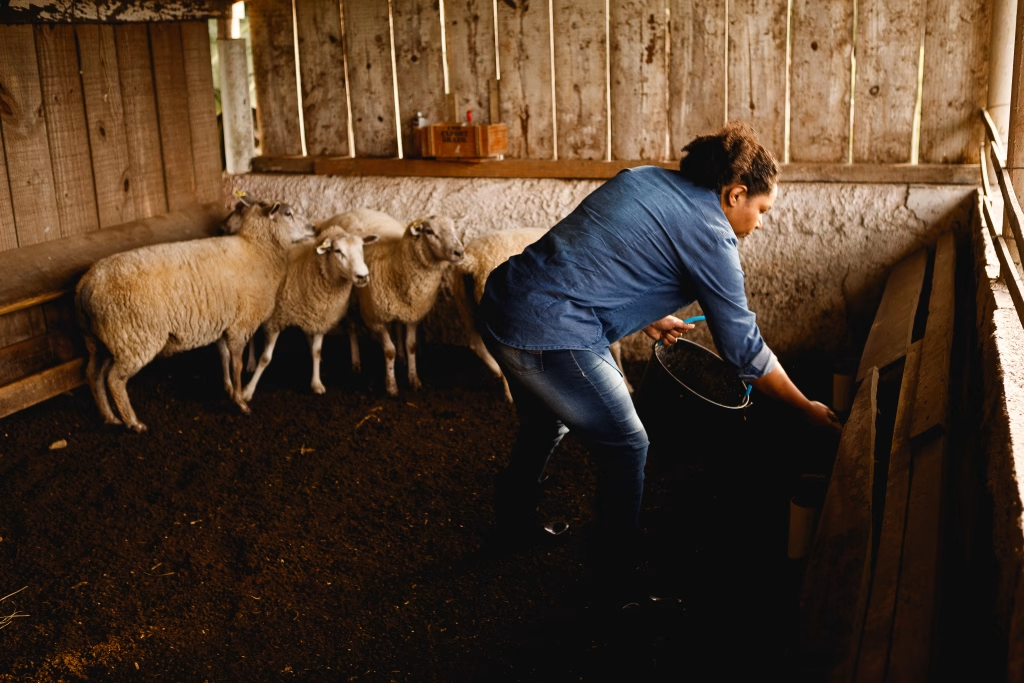
Each deck has designated hospital pen space. When an animal needs treatment, Elena works with another skilled stock handler to move it carefully there, where it’ll have more room, more access to the trough, and where any procedure it needs can be carried out.
It’s a two-person job. No one moves a large animal alone, safely, on a ship in motion.
Afternoon feeding offers another chance to watch: how much they’re eating, how they move around the troughs, whether there’s competition for space, whether anything has shifted in the group’s harmony. Small signals, but ones Elena has learned to read.
At the end of the day, she returns to the hospital pens to check on the animals under treatment. Then, one last lap of the vessel before calling it done.
The next morning, it all starts again.
What holds the system together?
From the outside, it might look like caring for animals on a vessel like this rests on one person: the veterinarian on board. Elena’s experience tells a different story.
Her work is held up by a much wider network: the stockpersons handling the animals, the crew preparing pens and maintaining the vessel, the officers overseeing operations, the systems supplying feed, water, ventilation and information. No one does this work alone. The mid-morning meeting, the daily report, the two-person effort to move an animal into a hospital pen — each is a small act of coordination holding up something far bigger than any single task.
Caring for animals, out at sea, is a shared responsibility, supported by standards but carried out through hundreds of decisions throughout a voyage. It’s sustained pen by pen, round by round, voyage after voyage, in the daily decisions of the people doing this work far from solid ground.
The Animal Echo aims to promote individual and collective understanding of animal health and welfare. We bring you insights and opinions from experts across the world. The opinions expressed in The Animal Echo are those of the author (s) and may not necessarily reflect WOAH’s official position.

Receive the latest updates from our Organisation, network, and partners.
This includes Members’ self-declarations, news articles, scientific insights, publications, and more.