When the textbook meets reality, antimicrobial resistance looks different
published on
11/19/2026
written by

Hui Wing CHAN
Hui Wing is the current International Veterinary Student Association Standing Committee on One Health Chair, actively supporting youth engagement in One Health issues and raising awareness of AMR among veterinary students.
Antimicrobial resistance (AMR) was involved everywhere in my curriculum throughout my five years of veterinary studies. On lecture slides, everything seems easy and direct: follow the clinical guidelines, culture the sample, run sensitivity testing and AMR risk will be minimised. In the classroom, AMR felt like a simple and straightforward academic exercise.
Students without practical experience often find it hard to understand the practicality, difficulties in implementing and the comprehension of AMR risk until it is at arm’s length. Outside the lecture hall, AMR stops being a guideline on paper but becomes an ever-struggling scale trying to balance between economics, biology and human reality.
The exotic clinic: When economics outweighs stewardship
Months ago, standing at the door of an exotic clinic, I was ready to put theoretical stewardship into action. It is all easy and standardised. But in clinics, the academic certainty fades in seconds.
One afternoon, a juvenile Sulcata tortoise, barely the size of my hand, came into the clinic. The tiny reptile was lethargic and in critical condition. Recognising the severity, the veterinarian suggested a blood test followed by bacterial culture and antimicrobial susceptibility test.
However, due to economic concerns, the owner denied the suggestion and opted for broad spectrum antibiotic treatment. When the price of the treatment doubles the price of an animal, it seems tempting to choose the cheaper option and hold onto the hope that the antibiotic might work. Two weeks later, the owner came back with the deteriorating animal. Facing the critical condition, they finally agreed to do the antibiotic resistance test.
The test results came back showing a multi-drug resistant bacterial strain. The veterinarian immediately adjusted the treatment plan. After that day, the owner never returned. To this day, I do not know if the tortoise survived.
Here, I saw that AMR prevention is never just about what we read in books. But the limitation in real life: AMR interventions fail when we ignore the human and economic reality on the ground. The animal could have suffered less with the proper antibiotics administered. It is a clear case showing how economic constraints limit the prevention of AMR, leading to suffering in animal welfare.
AMR in non-mammal species is often neglected. Protecting these animals requires promotion of responsible pet ownership and education to generate public awareness. Things like that happen in our day-to-day routine. Without a strict follow on antimicrobial stewardship, it will just be another afternoon with sick reptiles coming in and leaving with broad spectrum antibiotics as default.
Pastures and Parasites: The neglected frontier
As my study expanded to production animals, it got me into realising AMR does not stop at the antibiotics we are using but also antihelmintic drug resistance. This often neglected part is secretly jeopardising global food security.
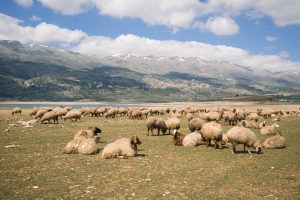
During pasture practice, I was again ready to discuss antihelminthic resistance by following procedures in books: maintaining refugia (leaving a proportion of the parasite population unselected by treatment), rotational grazing and proper vaccination.
But on the farm, it is not about a vision of the bright future without AMR but the livelihood of the farmers. It was difficult to manage economic income, maintain refugia and change the management system. What is more than that is routine fecal egg count testing seems out of reach when regional diagnostic laboratories are distant. The limited availability of local research on AMR risks also makes it challenging to raise awareness and communicate the importance of the issue effectively.
This made me realise that AMR prevention is also about building a local surveillance database and regional diagnostic infrastructure. Without diagnostic capacity, asking farmers to follow AMR guidelines is just like handing them a destination without a map.
AMR and One Health: Breaking the profession boundaries
AMR is more than just treating an animal the correct way, but also about making the interconnections between the health of humans, animals and the environment.
The inappropriate use of antimicrobials creates a selection pressure that encourages the development of AMR across human clinics, companion animal hospitals and livestock operations. Beyond that, the leak of residual antimicrobials to the environment also leads to contamination, causing our ecosystem to be the silent genetic reservoir. When the resistant pathogen enters the food chain and water supplies, human and animal health will face the threat of untreatable superbugs, which broadens the issue to food safety and food security in humans.
As this year’s World AMR Awareness Week calls for One Health in action, the need for collaboration across professions and sectors remains as important as ever.
Breaking the vicious cycle of antimicrobial resistance will require stronger cross-sectoral collaboration between veterinarians, medical doctors, pharmacists and ecologists. Multisectoral involvement is needed to facilitate collaborative work on AMR prevention.
Youth engagement: Build interdisciplinary mindset in early studies
Antimicrobials are a non-renewable resource. We cannot afford the consequences of AMR. As youth being the future pillars of society, we must practice the interdisciplinary mindset and the proper understanding of the limitations with empathy.
Building bridges with youth leaders in different sectors is of utmost importance. Being experts in our profession is simply not enough, we have to learn to think from a different perspective to establish One Health before stepping into clinical leadership.
Moving from treatment to prevention is the next step. Preventing AMR simply from reducing the treatment with antimicrobial is a fail recipe. A thorough understanding of the current constraint pushes us towards the direction of building a thorough surveillance database and comprehensive research to provide understanding and development of preventative measures like vaccination.
Tackling AMR goes beyond using fewer antimicrobials. It requires understanding the realities faced by those on the ground and bringing together different professions and generations to find solutions that work in practice. It is about how we work together: from veterinary students to veterinarians to pet owners and farmers, from pharmacists to medical workers.
We are not only protecting the effectiveness of medicine today; we are also saving lives tomorrow.
The Animal Echo aims to promote individual and collective understanding of animal health and welfare. We bring you insights and opinions from experts across the world. The opinions expressed in The Animal Echo are those of the author (s) and may not necessarily reflect WOAH’s official position.
Continue reading

Receive the latest updates from our Organisation, network, and partners.
This includes Members’ self-declarations, news articles, scientific insights, publications, and more.