How India’s innovation system is enabling stronger private sector engagement in animal health
published on
05/21/2026
written by

Dr Praveen Malik
Dr Malik currently serves as the CEO of Agrinnovate India Ltd. and Principal Scientist at Indian Council of Agricultural Research. With over 30 years of experience in animal health research, policy, and institutional management, he has held leadership roles as Animal Husbandry Commissioner (Chief Veterinary Officer of India) and as Director of the CCS National Institute of Animal Health.

Interviewer: Rahul Srivastava
Rahul is a Targeted Support Senior Programme Manager in WOAH’s Capacity Building Department, Dr Srivastava, coordinates the PVS Targeted Support portfolio to help Members develop the enabling environment for effective private-sector engagement and workforce development. He holds a Master’s of Veterinary Medicine and an MBA in Agribusiness, with 18 years’ experience across the public, private, and international development sectors.
India’s animal health sector is undergoing significant transformation. Behind the scenes, public research institutions, private companies, policymakers, financiers, and veterinarians are learning how to work together in new ways.
This shift has been intentional. It is the outcome of deliberate efforts to shape a system where public research, private enterprise, policy, finance, and frontline animal health workers are better aligned around shared priorities. At its core, is a growing recognition that effective public-private partnerships (PPPs) depend on far more than financial investment alone. They require early, continuous, and trust-based engagement among policymakers, public research institutions, private industry, financiers, and a capable workforce, guided by a shared purpose: animal health is everyone’s health.
These dynamics were explored in conversation with Dr. Praveen Malik, Chief Executive Officer of Agrinnovate India Limited, on how PPP engagement can be translated to tangible outcomes, and what lessons it may offer other countries.
From policy vision to institutional practice
How did Agrinnovate India Limited come into existence, and what gap was it designed to address?
Dr Praveen Malik: Agrinnovate was incorporated on 19 October 2011 as a public sector company under the Department of Agricultural Research and Education, Government of India. Its creation followed the outcome of the deliberations on the potential of PPP in agriculture and allied sectors during the “Interface” organised by the Indian Council of Agricultural Research (ICAR) in January 2006, which formally recognised the need for structured engagement between public research and the private sector.
ICAR invested in building a technology management ecosystem, covering intellectual property protection, valuation, licensing, and partnership frameworks. In doing so, it also strengthened the scientific workforce by enhancing awareness and capabilities in intellectual property and technology management among scientists, innovators, and emerging entrepreneurs. Therefore, enabling them to effectively translate research into partnerships and practical innovations.
Agrinnovate serves as a commercial interface between ICAR and external stakeholders. Today, Agrinnovate operates as a sustainable PPP model, balancing public mandate with commercial discipline.
Sustainability through a blended public-private model
How is this model sustained, and how do public and private investments work together?
Dr Malik: Our sustainability comes from shared value creation. Agrinnovate focuses on scouting the right opportunities at the right time for both partners.
Public investment supports upstream research, national laboratories, and infrastructure—particularly in high-risk or low-commercial-return areas of animal health. Private partners bring product development capability, manufacturing scale, regulatory expertise, and market access—ensuring public research reaches farmers and animal health systems efficiently.
In 2024-25 alone, Agrinnovate commercialised 155 technologies, generating INR 10.51 crore (approx. US$ 1.2 million) in revenue. In FY 2023-24, the company declared its first-ever dividend, reflecting financial maturity and accountability. These revenues are reinvested into technology generation, management, and partnership development.
What are the top PPP activities India focuses on in animal health?
Dr Malik: Some key areas define our engagement:
- Need-based technology development and commercialisation, particularly vaccines and diagnostics aligned with national priorities. For example, the African Swine Fever (ASF) vaccine candidate is in the final stage of development and is currently undergoing field validation, with demand already clearly recognised. In parallel, efforts are focused on developing easy-to-use point-of-care diagnostics, such as lateral flow assays for Surra, as well as user-friendly pregnancy diagnosis tools for animals to support timely and effective field-level decision-making.
- Strengthening preparedness for emerging and re-emerging animal health threats through targeted technology transfers to commercial manufacturers. This includes vaccine technologies for Foot and mouth disease (FMD), avian influenza and lumpy skin disease. Technology transfer of FMD virus strains has been undertaken following vaccine-matching studies to ensure the production of vaccines that are closely aligned with circulating field strains and provide optimal protection
- Shared use of public research infrastructure: The use of public infrastructure by the private sector to maximise national research assets and avoid duplication. For example, ICAR-National Institute of foot and mouth disease (ICAR-NIFMD)2, a national referral laboratory, provides access to its high-biocontainment facilities and advanced equipment to external stakeholders on a chargeable basis, in line with the ICAR Rules and Guidelines for Professional Service Function – 2014, thereby strengthening public-private partnerships.
- Fiscal support and financing mechanisms: In India’s Union Budget 2026-27, public investment in livestock, animal husbandry and allied sectors significantly increased to ₹8,915.26 crore (about US$ 1.07 billion) for the Ministry of Fisheries, Animal Husbandry and Dairying, up from ₹7,544 crore (≈ US$ 0.91 billion) in Budget 2025-26, an increase of over 18 %.
These increased investments alongisde support programmes, such as credit-linked capital subsidies and funds encourage entrepreneurship, enable private-sector participation in veterinary education, and support private investment in processing, diagnostics, and rural enterprises across the livestock value chain.
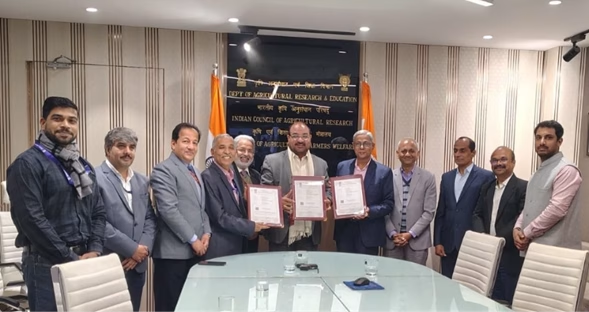
Agrinnovate India Ltd. (AgIn), DARE, facilitating the transfer of three FMD vaccine technologies developed by ICAR-NIFMD, to M/s Reliance Life Sciences.
How have policy reforms and ease-of-doing-business initiatives influenced private sector engagement?
Dr Malik: Beyond financing, regulatory rationalisation and process efficiency have been decisive. India has undertaken systematic efforts to reduce redundant laws, overlapping mandates, and legacy procedures that previously slowed innovation.
The current Government of India has progressively strengthened structured engagement with the private sector in the animal health domain to ensure transparency, scientific rigour, and ease of doing business. The government is actively streamlining redundant laws and regulations to strengthen transparency and accountability, creating a more predictable environment that encourages structured private sector participation.
On the regulatory front, the Department of Animal Husbandry and Dairying has introduced digital systems such as the Nandi portal for veterinary biological applications, improving traceability and efficiency in regulatory submissions. In parallel, companies engage with the Central Drugs Standard Control Organisation through the Sugam online portal, allows transparent submission, review, and representation of cases.
Together, these systems provide private companies with clearer processes, faster approvals, and structured opportunities to present scientific justifications—strengthening regulatory confidence while encouraging greater private sector participation.
Importantly, the innovation ecosystem is no longer linear. Innovation can originate from public institutions, private companies, or start-ups—with government providing financial, technical, and policy support across the spectrum.
What three insights would you share with the global animal health community?
Dr Malik: The first is the timely and inclusive stakeholder engagement at all levels, from policy design to adoption. Also, key is strengthening the animal health workforce that drives these processes on the ground, including scientists, veterinarians, and technical professionals.
Clarity of roles matters. Public sector leadership in policy and regulation, structured private sector participation in development and scale. Transparency and strong institutional systems ensure sustainability. PPPs must be embedded within organisations, not dependent on individuals, while also building institutional capacity and skills within the workforce that sustains these partnerships over time.
Countries aspiring to strengthen their animal health systems through public-private partnerships should move beyond ad hoc collaborations and establish structured, policy-backed institutional mechanisms.
Governments can play a catalytic role by:
- creating transparent IP and licensing frameworks,
- aligning academic performance metrics with translational impact,
- streamlining regulatory pathways without diluting quality standards.
- facilitating early industry engagement in publicly funded research. Dedicated interface institutions—tasked with technology management, stakeholder coordination, and conflict resolution—can significantly reduce transaction costs and build trust.
Above all, countries should view PPPs not merely as financing instruments, but as long-term system-building tools that strengthen preparedness, innovation capacity, and equitable access to animal health solutions.
If carefully designed and institutionally embedded, such partnerships can become strategic pillars for food security, economic resilience, and global public health.
The Animal Echo aims to promote individual and collective understanding of animal health and welfare. We bring you insights and opinions from experts across the world. The opinions expressed in The Animal Echo are those of the author (s) and may not necessarily reflect WOAH’s official position.
Continue reading



Receive the latest updates from our Organisation, network, and partners.
This includes Members’ self-declarations, news articles, scientific insights, publications, and more.