Capacity, Collaboration and Capital: Building Veterinary Services Fit for the Future
published on
05/18/2026
written by

Hana Abdelsattar
Hana is Senior Training Programme Manager in the Capacity-Building Department of the World Organisation for Animal Health (WOAH), with extensive experience of capacity building in international organisations. She holds a Master’s degree in Management and Communication, and leads the development of WOAH’s eLearning platform, designed to meet diverse learning needs and uphold the Organisation’s standards. Dedicated to accessible, learner-centred training systems that build global capacity, Hana works to strengthen global Veterinary Services, equipping them to address both current and emerging challenges.

Jennifer Lasley
Jennifer is Senior Programme Coordinator for the PVS Pathway and WHO/IHR Connections in WOAH’s Capacity Building Department. She has worked at WOAH since 2010, and her most recent projects focus on the digitalisation of the PVS Pathway and the development of key performance indicators, dashboards and analytical tools to support advocacy efforts. These tools use natural language processing and machine learning to extract added value and insights from global data on the performance of animal health systems.
Camille Loi
Camille is Programme Manager of the Veterinary Legislation Support Programme (VLSP), a PVS Targeted Support initiative that provides recommendations and assistance for national legal reforms in line with WOAH international standards. She holds a Master’s in Human Rights and International Humanitarian Law and a Master’s in European Affairs and Law. She has worked at WOAH for 12 years, building on prior experience in French institutions and international non-governmental organisations, with expertise in legal matters and development cooperation.

Valentyna Sharandak
PVS Pathway Programme Manager in WOAH’s Capacity-Building Department, Valentyna holds a PhD in Veterinary Microbiology and Virology, and has seven years’ experience in the position of Chief of Unit for the International and European Cooperation Directorate for International Collaboration in the Veterinary Services of Ukraine.

Rahul Srivastava
Public-Private Partnership (PPP) Project Manager in WOAH’s Capacity Building Department, Dr Srivastava is leading efforts to integrate PPPs within the PVS Pathway and promote collaboration with stakeholders globally. He holds a Masters in Veterinary Medicine and an MBA in Agribusiness, with 17 years of experience across public, private, and international development sectors in South Asia and Africa.

Barbara Alessandrini
Head of WOAH’s Capacity-Building Department, Barbara leads the WOAH capacity-building programme, which includes the PVS Pathway Programme and the Training Platform, promoting innovation in country-led services and in learner-centred training, to empower both institutions and individuals to welcome cultural and operational change, including the One Health approach.
Abstract
Veterinary Services are central to animal health, food security, economic stability and One Health outcomes, yet persistent gaps in capacity, investment and governance continue to limit their effectiveness in many countries. This article proposes a coherent framework built on three interdependent pillars – Capacity, Collaboration and Capital – to guide sustainable reform. It shows that traditional capacity building, often focused narrowly on short-term training, must evolve towards the systemic strengthening of institutions, legal frameworks, leadership and workforce development, anchored in evidence from the Performance of Veterinary Services (PVS) Pathway of the World Organisation for Animal Health (WOAH). Collaboration is presented as a structured, demand-driven ecosystem that aligns national priorities with regional and global partnerships, supporting cross-sectoral One Health action and resilient governance. Capital is considered broadly, encompassing not only financial investment but also human, institutional, legal, social and knowledge resources, all of which remain chronically underbalanced in many contexts. The article demonstrates that only integrated investment across these three pillars can deliver lasting improvements, enabling Veterinary Services to address emerging health, economic and environmental challenges to remain fit for the future.
Strong animal health systems don’t emerge by chance. They are built deliberately through sustained investment in people, institutions, legal reforms, partnerships and resources. Yet, despite decades of effort, significant gaps persist across Veterinary Services globally, particularly in low- and middle-income countries where disease pressure is high, workforce capacity remains constrained [1,2], and regulatory and institutional frameworks require consolidation. One reason for this underinvestment is that Veterinary Services are still viewed primarily through a disease-control lens, rather than as a broader public good that supports trade, food security, livelihoods and One Health objectives [1,3]. In some settings, the institutional model of Veterinary Services also reflects an earlier era, when the scale and complexity of transboundary animal diseases, antimicrobial resistance, climate-related risks and biological threats were less pronounced [3]. These challenges are compounded by competing national priorities for public investment.
Three interconnected pillars – Capacity, Collaboration and Capital – provide a strategic and holistic approach to reduce these gaps and achieve good governance, widely recognised as a global public good and crucial for ensuring the efficiency and resilience of Veterinary Services [1,2]. However, questions remain about whether current national, regional and global interventions are delivering results at scale, and what it will take to build Veterinary Services that are truly fit for the challenges ahead.
Capacity without capital erodes. Collaboration without capacity leads to engagement without delivery. Capital without capacity yields limited returns.
Capacity: Beyond Training Events
Capacity building in animal health has long been associated with short-term training. Workshops are organised, knowledge is transferred and participants return to their institutions, often without the influence or authority needed to drive systemic change. While valuable in isolation, this model is insufficient at scale.
The Capacity Building Department of the World Organisation for Animal Health (WOAH), working closely with technical departments and Regional and Sub-Regional Representations, has shifted towards a more integrated model that strengthens knowledge, skills, competencies, systems and institutions simultaneously. The Performance of Veterinary Services (PVS) Pathway – WOAH’s internationally recognised benchmarking, costing and capacity building programme – provides a structured framework to identify gaps in Veterinary Services and prioritise targeted interventions [4].
PVS Evaluations identify systemic weaknesses and propose actionable recommendations. However, translating these findings into financed, sustained national action plans is not automatic, as is often the case in other public health interventions. Advocacy has also become tougher, given competing priorities and the zero-sum competition for resources between ministries [4].
New initiatives like the PVS Self-Assessment Annual Report are helping to shift the focus from assessment to institutional behaviour change. They provide a clearer picture of the actions WOAH Members(¹) are taking in response to recommendations made in the PVS Evaluation and the progress achieved. While Members say they value this opportunity to take stock of their achievements, and indicate that action has been taken on 83% of recommendations [5], fewer than half are supported by sufficient resources. Financial, human and physical constraints, along with competing priorities, are still the main barriers to implementation(²).
Good governance and institutional resilience require not only trained personnel, but also functional laboratory networks, high-quality legislation aligned with and effectively enforcing international standards, reliable coordination mechanisms and sustained political commitment [6].
Where these systemic enablers are absent, even well-designed training programmes struggle to deliver lasting results beyond individual benefits. A shift is needed: from measuring training outputs to evaluating long-term performance outcomes. Reflecting on WOAH’s Leadership in Veterinary Services training held in March 2026 in Chiang Mai, Thailand, one participant noted: ‘I feel truly empowered, not only as a veterinary leader, but also as a woman finding my voice and contributing meaningfully to decision-making processes within Veterinary Services.’ Such outcomes, where technical learning translates into professional agency and leadership, represent the intended impact of capacity-building efforts.
Veterinary Services should be recognised as a vital public good – supporting trade, food security, livelihoods and One Health objectives, far beyond their role in disease control.
Collaboration: From Ad Hoc Support to Coordinated Partnerships and Systems
Collaboration at WOAH has evolved from ad hoc technical support into a more structured, demand-driven learning ecosystem that responds directly to Members’ needs through a diverse network of institutional, financial and technical partners. These include government and non-governmental organisations, as well as WOAH Collaborating Centres [7], which provide specialised expertise.
Capacity building initiatives are no longer delivered as isolated interventions but are increasingly designed in response to identified Member needs and regional priorities. This approach is supported by context-specific knowledge exchange, gap assessments and shared learning.
In this context, WOAH’s capacity building efforts focus on strengthening the legal and institutional environment needed for effective Veterinary Services and sustainable public–private partnerships (PPPs). Through the PVS Pathway, Members receive tailored support, including the Veterinary Legislation Support Programme (VLSP), which helps modernise legal frameworks, and PPP Targeted Support, which facilitates structured engagement between public and private actors [4,7].
These interventions are complemented by workforce development initiatives, laboratory strengthening and National Bridging Workshops (NBWs), ensuring inclusive engagement across the veterinary workforce. Together, these integrated efforts reinforce governance, capacity and collaboration, contributing to more resilient and effective animal health systems [4,7].
More fundamentally, the complexity of today’s global challenges – including the growing demand for foods of animal origin, antimicrobial resistance, zoonotic spillover, climate-driven disease emergence and increasing biological threats – makes siloed approaches no longer viable. The One Health approach requires veterinary, human health and environmental professionals to work within shared frameworks rather than in parallel systems [3].
Cross-sectoral coordination mechanisms – such as the Joint One Health Learning Taskforce of the Food and Agriculture Organization of the United Nations (FAO), the World Health Organization (WHO) and WOAH – represent meaningful progress. However, their impact will depend on long-term institutionalisation rather than short-term, project-based engagement [3]. Engagement in the PVS Pathway and related support mechanisms also varies over time, reflecting evolving national priorities, leadership changes, resource constraints and the extent to which countries see a clear pathway from assessment to action and financing. Where the link between findings and mobilised support is clear, demand tends to be stronger; where it is weak, incentives to engage may diminish.
There is also a structural challenge: collaboration requires resources. Informal networks are often fragile, and significant transaction costs are needed for sustained, multi-institutional partnerships – from aligning priorities to managing governance. Future collaboration models must be deliberately resourced, with well-defined roles, shared accountability, set outcomes and mechanisms that can withstand personnel changes and funding cycles.
Emerging learner‑centred approaches are promising, such as Learning Needs Assessment, which combines survey data with insights from PVS data supported by artificial intelligence. Such approaches enable the development of data-driven training architectures, aligning training topics, audiences and formats with documented competency gaps, and are underpinned by tools and dashboards that inform strategic decision-making [6,8].
The acquisition of talents during education, study, or apprenticeship… is capital in a person. Those talents are part of his fortune and likewise that of society.
– Adam Smith, The Wealth of Nations (1776)
Capital: Mobilising Financial and Knowledge Resources Together
The Organisation for Economic Co-operation and Development (OECD) notes that investing in human capital improves employment, productivity and economic outcomes [10]. The World Bank goes further, describing human capital as ‘a principal determinant of aggregate economic growth rates, and… key to reducing poverty and inequality’ [11]. These observations are highly relevant to the veterinary sector, where chronic underinvestment limits both individual career pathways and systemic health security.
In this context, capital extends beyond financial resources. It encompasses financial capital (grants, loans and domestic budgets), human capital (workforce and expertise), institutional and legislative capital (frameworks that underpin effective governance and operational capacity), social capital (trust and networks), and physical and digital capital (laboratories, information systems and learning platforms).
The current landscape remains uneven. Domestic financing for animal health is low in many countries, and alignment between donor priorities and nationally identified needs is often limited. Data from WOAH’s PVS Pathway Information System indicate that the annual budget allocated to Veterinary Services represents, on average, just 0.05% of total national GDP() and around 1% of agriculture GDP(⁴) [8,10,12]. Estimates suggest that budgets would need to increase by approximately 52%(⁵) to meet performance and capacity targets to comply with WOAH international standards and national priorities [10].
To address these funding gaps, international donors often fund specific response or a succession of short-term projects. However, the long-term structural investments needed to strengthen Veterinary Services’ capacity and governance remain chronically underfunded, such as competitive salaries, functional infrastructure, operational budgets and sustainable reforms (legal and educational).
At the same time, knowledge infrastructure is expanding. Increased use of system data, dashboards that summarise strengths, weaknesses and recommendations, as well as blended learning approaches combining online modules with face‑to‑face training are all contributing to a more modern capacity building approach [6,8]. Of course, these advances must be matched by sufficient funding to enable Veterinary Services to recruit, retain and continuously develop staff, maintain laboratories and information systems, and implement the identified reforms through assessments and learning needs analyses. With adequate resourcing, these tools can reach their full potential and significantly amplify impact.
A Coherent Framework for Systemic Change
The real value of the Capacity–Collaboration–Capital framework lies not in the individual pillars, but in how they work together. Capacity without capital erodes. Collaboration without capacity leads to engagement without delivery. Capital without capacity yields limited returns.
The PVS Pathway Capacity–Collaboration–Capital framework identifies three interconnected drivers of sustainable impact. Capacity refers to the skills, systems and organisational capabilities needed to design, implement and adapt interventions effectively. Collaboration emphasises the importance of strategic partnerships – across teams, institutions and communities – in aligning goals, sharing knowledge and drawing on complementary strengths. Capital encompasses the financial, human, institutional, legal and social resources needed to scale initiatives and ensure long‑term resilience. Together, these elements form a balanced approach that strengthens programme delivery, improves collective effectiveness and supports lasting, meaningful outcomes.
WOAH’s vision of strong animal health systems, recognised as critical in tackling global challenges, is achievable. However, it demands an integrated approach at every level [1]: in how programmes are designed, how partnerships are structured and how resources are secured and allocated. As animal health systems face growing pressure from climate change, demographic shifts and emerging disease threats, the margin for fragmented, under‑resourced approaches is narrowing.
The PVS three‑pillar model offers a practical and analytically grounded path forward. What it now needs is rigorous application, independent evaluation, and political and financial commitment to match its ambition. Veterinary Services need capacity building that is coherent, data‑driven and adequately resourced – truly fit for the future they are expected to support.
(1) WOAH Members: countries and territories.
(2) As reported by Delegates in the first-ever PVS Self-Assessment Annual Report (n = 49) launched in 2025.
(3) n = 54 WOAH Members, data collected through Gap Analysis since 2010.
(4) n = 54 WOAH Members, data collected through Gap Analysis since 2010.
(5) n = 54 WOAH Members, data collected through Gap Analysis since 2010.
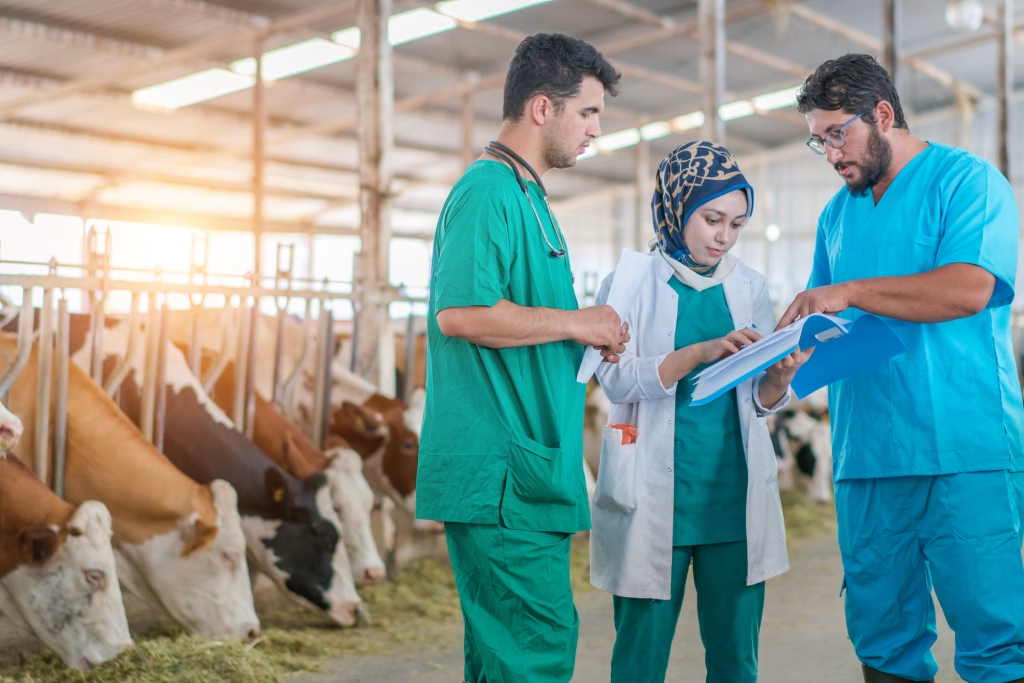
Main image: ©mgstudyo, Getty Images
References
[1] World Organisation for Animal Health (WOAH). Strategy – WOAH Strategic Plan. Paris (France): WOAH; 2026. Available at: https://www.woah.org/en/who-we-are/strategy/ (accessed on 30 April 2026).
[2] World Organisation for Animal Health (WOAH). The Science System of the World Organisation for Animal Health. Paris (France): WOAH; 2024. https://doi.org/10.20506/woah.3534
[3] Food and Agriculture Organization of the United Nations (FAO), United Nations Environment Programme, World Health Organization, World Organisation for Animal Health. One Health Joint Plan of Action, 2022–2026. Rome (Italy): FAO; 2022. Available at: https://www.woah.org/app/uploads/2022/04/one-health-joint-plan-of-action-final.pdf (accessed on 30 April 2026).
[4] World Organisation for Animal Health (WOAH). PVS Pathway: Performance of Veterinary Services. Paris (France): WOAH; 2023. Available at: https://www.woah.org/en/what-we-offer/improving-veterinary-services/pvs-pathway/ (accessed on 30 April 2026).
[5] World Organisation for Animal Health (WOAH). PVS Self-Assessment Annual Report 2025. Paris (France): WOAH; 2025.
[6] World Organisation for Animal Health (WOAH). Monitoring performance of Veterinary Services – Observatory Monitoring Report. Paris (France): WOAH; 2023. Available at: https://www.woah.org/en/what-we-do/standards/observatory/implementation-of-standards-the-observatory-monitoring-report/monitoring-performance-of-veterinary-services/ (accessed on 30 April 2026).
[7] World Organisation for Animal Health (WOAH). One Health capacity building at WOAH. Bull WOAH. 2022;2022(1). https://doi.org/10.20506/bull.2022.1.3296
[8] World Organisation for Animal Health (WOAH). PVS Pathway Information System. Paris (France): WOAH; 2026. Available at: https://pvs.woah.org/portal (accessed on 19 March 2026).
[9] Smith A. An Inquiry into the Nature and Causes of the Wealth of Nations. New York (United States of America): Modern Library; 1937. Original work published 1776.
[10] Organisation for Economic Co-operation and Development (OECD). The importance of human capital for economic outcomes. Paris: OECD; 2022. Available at: https://one.oecd.org/document/EDU/EDPC(2022)2/en/pdf (accessed on 30 April 2026).
[11] World Bank. Human Capital and Poverty Alleviation. Washington, DC (United States of America: World Bank Group; 1995. Available at: https://documents1.worldbank.org/curated/en/121791468764735830/pdf/multi0page.pdf (accessed on 30 April 2026).
[12] World Organisation for Animal Health (WOAH). Gap Analysis Financial Indicators, PVS Pathway Insights, PVS Pathway Information System. Paris (France): WOAH; 2026. Available at: https://www.woah.org/en/what-we-do/standards/observatory/implementation-of-standards-the-observatory-monitoring-report/monitoring-performance-of-veterinary-services/ (accessed on 30 April 2026).
Continue reading


Receive the latest updates from our Organisation, network, and partners.
This includes Members’ self-declarations, news articles, scientific insights, publications, and more.