Why Strong Veterinary Statutory Bodies Matter
published on
06/30/2026
written by

Lynette Havinga
Lynette is a Technical Expert on Veterinary Statutory Bodies with the World Organisation for Animal Health (WOAH), a position she has held since 2020. She previously served the South African Veterinary Council (SAVC) for 27 years, including as Vice-Registrar and Registrar. In recognition of her contributions to the veterinary profession, she received a Citation from the South African Veterinary Association (SAVA) in 2008 and was awarded Honorary Associate Life Membership in 2020. Lynette holds a BA Honours degree in International Politics from the University of Pretoria and a Project Management Certificate from the University of Cape Town. Lynette is passionate about South Africa’s animal, wildlife and bird heritage and spends her free time in nature.
Abstract
A well-functioning veterinary workforce relies on effective governance to ensure competence, accountability and public trust. Veterinary Statutory Bodies (VSBs) provide this foundation by regulating veterinary and para-veterinary professions in line with World Organisation for Animal Health (WOAH) standards. This article uses the South African Veterinary Council (SAVC) to show how a strong, autonomous VSB can be a strategic asset for workforce governance. Established under the Veterinary and Para-Veterinary Professions Act (1982), the SAVC demonstrates how a robust legislative framework, implemented consistently and ethically, can safeguard professional integrity and protect the public interest. Through functions such as setting education standards, registering professionals, accrediting training programmes and continuing professional development, as well as overseeing disciplinary processes, the Council ensures that veterinary services are delivered by competent professionals. The SAVC’s integrated approach supports animal health, food safety, trade and One Health objectives while protecting practitioners through clear scopes of practice and due process. Its maintenance of comprehensive registers and use of data-driven decision-making further strengthen workforce planning and service delivery. The SAVC is an example of how strong VSBs are not administrative burdens but essential for resilient veterinary systems, economic competitiveness and global health security.
Lessons from the South African Veterinary Council (SAVC)
A veterinary workforce can only fulfil its mandate when supported by effective governance. Even the most skilled professionals cannot protect animal health, food systems or public health without a framework that maintains competence and accountability. This is the role of a Veterinary Statutory Body (VSB) [1,2]. Around the world, VSBs provide the legislative and regulatory foundation that ensures veterinarians and veterinary paraprofessionals (VPPs) are competent, accountable and fit to practice in line with World Organisation for Animal Health (WOAH) standards.
The South African Veterinary Council (SAVC) is South Africa’s VSB. Its predecessor, the South African Veterinary Board, was established in 1933 under the Veterinary Act 1933 (Act No. 16 of 1933) [1]. In 1982, the SAVC became an independent, self-funding statutory body under the Veterinary and Para-Veterinary Professions Act 1982 (Act No. 19 of 1982). Its mandate is to ensure that the people of South Africa receive quality veterinary care that meets the country’s needs and aligns with international best-practice standards. As custodian of the veterinary and para-veterinary professions in South Africa, the SAVC enables professionals to practise ethically and creates a safe environment for all.
A Legislative Foundation That Protects the Public
A VSB is only as effective as the legislation that underpins it. However, legislation has little value unless it is implemented with integrity and consistency. The SAVC operates under a comprehensive Act of Parliament that defines its mandate, powers and independence. Through this Act, Parliament delegates responsibility for regulating the veterinary and para-veterinary professions to the Council. This legal framework remains largely insulated from political or commercial interests, a core WOAH principle [3-5].
The Council’s composition [6] reflects this independence. Veterinarians, VPPs, academics, government representatives and legal experts all contribute to transparent and accountable decision-making. The SAVC also operates through a committee system, with each committee working under clear terms of reference, so that decisions are evidence-based, fair and professionally grounded.
Even the most carefully drafted legislation becomes ineffective if it is not applied, monitored and enforced. Implementation is where the law comes to life: standards are upheld, risks are managed and the public is protected. Without effective implementation, a Veterinary Act is little more than words on paper, unable to provide the accountability, professional oversight and public-interest safeguards it was designed to deliver.
This is the first return on investment: a VSB is a trusted and independent institution that protects both the public and registered professionals by ensuring that everyone providing veterinary services meets the same minimum standards.
Protecting the Veterinary Workforce That Safeguards Animal Health and Food Systems
Veterinarians and VPPs underpin animal health, food safety and economic resilience. WOAH recognises veterinary services as a global public good, making it essential to protect the veterinary workforce [4,5].
By setting standards for education, registration and professional conduct, VSBs maintain the credibility of the profession and public confidence in veterinary services [3,7]. At the same time, they provide a framework that supports professionals through clear guidance, recognition of qualifications and due process in disciplinary matters. This promotes fairness while safeguarding practitioners’ rights through defined scopes of practice, legal recognition of their role and protection against arbitrary or unjust professional sanctions. In this dual role, VSBs maintain a balanced system that serves the public interest while supporting professionals in practising with confidence and legitimacy.
The SAVC regulates veterinary professionals and five categories of VPPs [7]. Each profession operates within its scope of practice aligned with day one competencies (i.e. competencies acquired for the first day of work after obtaining the required qualification), ensuring that those delivering services are competent, accountable and ethically bound. Veterinarians have been formally registered in South Africa since 1933 and VPPs since the 1980s. The SAVC progressively expanded the registration of VPPs as their contribution to service delivery, surveillance and animal care became increasingly evident [7]. This long regulatory history reflects the deliberate, evidence-based evolution of the veterinary workforce in response to the country’s changing needs. Through this framework, the SAVC supports surveillance, diagnostics, research, as well as animal health and welfare systems, forming the often unseen infrastructure that keeps animals healthy and food systems safe.
Even the most skilled professionals cannot protect animal health, food systems or public health without a framework that maintains competence and accountability.
Ensuring the Quality, Safety and Credibility of Veterinary Services
VSBs play a vital role in ensuring that only qualified individuals are authorised to practise. The SAVC fulfils this mandate by setting and monitoring minimum training standards, conducting institutional accreditation every 5–8 years, accrediting continuing professional development (CPD) providers and maintaining public registers of registered professionals and authorised persons. Although these functions may appear administrative, they are essential safeguards that ensure every veterinarian and VPP entering the workforce meets WOAH-aligned standards and that the public can trust the services they receive.
The SAVC’s authority is reinforced by Section 23(1)(c) of its Act [6], which states that no person may provide veterinary or para-veterinary services unless they are registered or formally authorised. This provision has been instrumental in maintaining professional standards and service quality.
During the 1990s, one of South Africa’s nine provincial governments employed unregistered personnel because of a shortage of animal health technicians. Rather than allowing unregulated practice to continue, the SAVC used this provision to bring the situation into compliance. The Council introduced a structured process through which affected personnel were assessed, authorised and required to pass examinations, demonstrate competence and work under the supervision of registered veterinarians and VPPs.
This approach protected the public while maintaining professional standards and addressing service delivery gaps. It remains a clear example of how a VSB can provide practical solutions without compromising the safeguards that protect communities.
Strengthening the Veterinary Workforce Ecosystem
Veterinary services depend on a diverse workforce that includes veterinarians, VPPs, scientists, technologists and support staff. Each group has distinct responsibilities and requires appropriate oversight [8,9].
The SAVC regulates all veterinary and VPP categories under a single legislative framework, with scopes of practice aligned to training and day one competencies. These scopes are regularly reviewed to support evolving service delivery models, including independent practice for certain VPPs [7]. In this way, the SAVC shapes how the workforce develops and operates, going beyond mere regulation.
By maintaining accurate registers, enforcing CPD and ethical requirements, and authorising individuals to provide services where gaps exist, the SAVC helps match veterinary teams with animal populations and geographic realities. This extends the reach of veterinary services, strengthens surveillance and supports access to essential care, including in underserved communities.
Accurate Registers: The Foundation of Workforce Planning
A complete, legally recognised register is far more than a list; it is a valuable workforce planning tool. Initially, the SAVC maintained all its records on paper. As recently as 1993, every entry, update and verification relied on manual systems. Over time, the Council invested in modernising its record-keeping processes, transitioning to electronic systems that now maintain comprehensive records of veterinarians, VPPs and students. These records provide authoritative proof of professional status and support government planning, oversight of training institutions, workforce deployment and ongoing workforce management.
Electronic systems have also transformed how the SAVC engages with professions. Regular communication with veterinarians and VPPs, including consultation on matters relating to day one competencies and scopes of practice, is now more effective, transparent and inclusive. This strengthens accountability and ensures that regulatory decisions are informed by those delivering services on the ground.
Recognising the importance of evidence-based workforce planning, the SAVC has commissioned several country-wide studies to better understand the demand for veterinary and para-veterinary services. These studies provide critical insights into service gaps, workforce distribution and future needs.
This is governance in action: using data to inform decisions and strengthen the veterinary services ecosystem.
Self-Regulation: Integrity and Professional Responsibility
Self-regulation is a hallmark of a mature profession, ensuring that professional standards are informed by scientific expertise and supported by those responsible for upholding them.
The SAVC oversees registration, annual renewals and CPD compliance, investigates complaints and conducts disciplinary inquiries. Clear procedures for investigation, inquiry, appeal and sanctions offer transparency and fairness throughout the process.
This system protects the public while promoting high professional standards and responsible practice without requiring direct state intervention. In turn, it promotes the public image of veterinarians and VPPs.
Supporting Economic Competitiveness and Trade
Animal health is a prerequisite for market access, and the credibility of veterinary certification directly affects a country’s ability to trade. The SAVC plays an important role in maintaining confidence in veterinary certifications. In the past, several veterinarians and a small number of VPPs in South Africa have faced disciplinary action for failure to complete certification documents in the prescribed manner. By aligning with WOAH standards, strengthening certification systems, and supporting surveillance and diagnostics, the SAVC contributes to the country’s standing in international evaluations and protects export markets. A strong VSB is therefore a trade asset.
One Health and Health Security
Most emerging infectious diseases are zoonotic, making veterinary professionals central to early detection and response.
The SAVC regulates animal health technicians [8] and other frontline surveillance personnel, and ensures that veterinary and laboratory animal technologists meet the standards required for diagnostic and research activities. In South Africa, veterinary technologists [2] play a key role in conducting laboratory analysis of specimens, helping veterinarians to confirm diagnoses. Through this oversight, the SAVC supports not only disease control, food safety and antimicrobial stewardship, but also broader health security.
Reducing Long-Term Costs Through Prevention
Effective regulation helps prevent crises. By setting standards for training, professional conduct and ethics, establishing minimum requirements for facilities that provide veterinary services and maintaining a fair disciplinary system, the SAVC reduces the risk of malpractice, unsafe practices and costly emergency responses.
Prevention is always cheaper than cure, and a strong VSB is an important investment in long-term prevention.
A VSB Is Not a Liability: It Is an Asset
The SAVC demonstrates the value of a mature, autonomous and high-performing VSB. Through its regulatory functions, it supports a competent veterinary workforce aligned with the needs of communities across the country.
Investing in VSBs is a strategic decision that strengthens governance, supports economic growth, facilitates trade and builds resilience. Rather than being an administrative burden, a VSB is an asset for communities, countries and global health security.
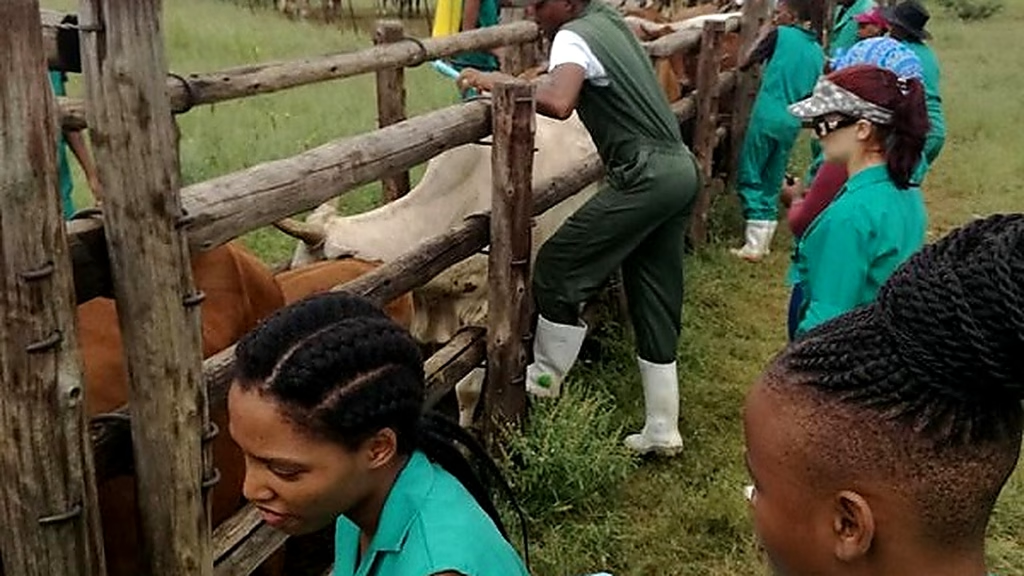
Main image: ©South African Veterinary Council
References
[1] Bastiaensen P, Rhissa Z, Avong MA, Moerane R, Ponella-Mlelwa T, Asfaw W, et al. Veterinary Statutory Bodies in Africa. In: Global Conference on Veterinary Education and the Role of the Veterinary Statutory Body: Ensuring excellence and ethics of the veterinary profession; 2013 Dec 4-6; Foz do Iguaçu, Brazil. Paris (France): World Organisation for Animal Health; 2013. Available at: http://bastiaensen.be/pdf/23-Bastiaensen-VSBs_in_Africa.pdf (accessed on 7 June 2026).
[2] Havinga L. Extraordinary report on future WOAH targeted activities in support of establishing and advancing Veterinary Statutory Bodies (VSBs). Paris (France): World Organisation for Animal Health; 2023. Internal report.
[3] Economides P. The role of Veterinary Statutory Bodies and associations in the promotion of the veterinary profession and upgrading of Veterinary Services. In: Proceedings of the OIE Conference on the Role of Veterinary Statutory Bodies; 2007. p. 165-73. Available at: https://www.woah.org/fileadmin/Home/eng/Publications_&_Documentation/docs/pdf/TT/2007_165-173_Economides.pdf (accessed on 7 June 2026).
[4] World Organisation for Animal Health. Veterinary Legislation Support Programme (VLSP): Volume 3 – Working examples. 2nd ed. Paris (France): World Organisation for Animal Health; 2016. Available at: https://rr-asia.woah.org/app/uploads/2021/05/vlsp-manual-part-3-sample-law-on-regulation-of-professions.pdf (accessed on 7 June 2026).
[5] World Organisation for Animal Health. Veterinary Legislation Support Programme (VLSP): Volume 1 – Technical guidance. 2nd ed. Paris (France): World Organisation for Animal Health; 2015. Available at: https://www.woah.org/app/uploads/2025/05/20250520-en-vlsp-overview-versionmay2025.pdf (accessed on 7 June 2026).
[6] South African Veterinary Council (SAVC). Veterinary and Para Veterinary Professions Act, 1982 (Act 19 of 1982), as amended. Pretoria (South Africa): SAVC; 2019. Available at: https://savc.org.za/wp-content/uploads/2021/05/024_Integrated-Act-19-of-1982-Updated-22-Feb-2019-1.pdf (accessed on 4 June 2026).
[7] Havinga L. OIE training: Purpose of a Veterinary Statutory Body (VSB). Paris (France): World Organisation for Animal Health; 2020. Paris. Internal training material.
[8] South African Veterinary Council (SAVC). Rules relating to the practising of the profession of animal health technician. Pretoria (South Africa): SAVC; 2022. Available at: https://savc.org.za/wp-content/uploads/2022/12/AHT-rules-9-Dec-2022.pdf (accessed on 4 June 2026).
[9] South African Veterinary Council (SAVC). Rules relating to the practising of the profession of veterinary technologist. Pretoria (South Africa): SAVC; 2022. Available at: https://savc.org.za/wp-content/uploads/2022/12/Vet-Techs-Rules-9-Dec-2022.pdf (accessed on 4 June 2026).
Continue reading

Receive the latest updates from our Organisation, network, and partners.
This includes Members’ self-declarations, news articles, scientific insights, publications, and more.