Invisible Challenges, Visible Action: A New One Health Microbial Forensics Capability for the UK
published on
12/19/2025
written by

Simon A. Weller
Dr Simon A. Weller is a Fellow of the Royal Society of Biology (FRSB) and a Senior Principal Scientist at the Defence Science and Technology Laboratory (DSTL), an Executive Agency of the United Kingdom Ministry of Defence. A molecular microbiologist with nearly 30 years’ experience in biosurveillance, he is currently Technical Authority of the United Kingdom Microbial Forensics Consortium (UKMFC), a new One Health capability being set up in the UK. Simon has extensive experience of working on various operational responses including the 2001 UK foot and mouth disease outbreak, the 2014 West Africa Ebola outbreak and the SARS-CoV-2 pandemic.
Graeme Clark
Professor Graeme Clark is Chief of Bioforensics and Attribution at the Defence Science and Technology Laboratory (DSTL) where he leads the Chemical Biological Analysis and Attribution Capability (CBAAC). A microbiologist with a deep technical specialism in toxinology, he represents DSTL and the UK as a biosecurity expert at the national, European Union and United Nations level. The UKMFC – in support of the UK Government’s Biological Security Strategy (2023) – realises and delivers upon his vision of improving the UK’s preparedness from the misuse of biological materials.
Rhiann Coffey
Rhiann Coffey is a graduate Forensic Scientist working as a Chemical and Biological (CB) Operational Exploitation Scientist at the Defence Science Technology Laboratory (DSTL). She is currently deputy lead of the Forensic Working Group (FWG) of the United Kingdom Microbial Forensics Consortium (UKMFC).
Dan Dorey-Robinson
Dr Dan Dorey-Robinson is a Senior Computational Biologist (Analysis and Attribution) at the Defence Science and Technology Laboratory (DSTL). With nearly 15 years’ experience in biosurveillance, he is currently lead bioinformatician of the United Kingdom Microbial Forensics Consortium (UKMFC). Dan has extensive experience in developing computational capability for the detection and characterisation of bacteria and viruses.
Jennifer Harris
Jennifer Harris is a Senior Project Manager with a strong track record of delivering complex research and innovation programmes within the United Kingdom’s defence and science sector. She currently leads multidisciplinary teams at the Defence Science and Technology Laboratory (DSTL), supporting strategic initiatives that span technology development, stakeholder engagement and operational delivery.
Sarah Lumley
Dr Sarah Lumley graduated from the University of Surrey with a PhD in Virology. Having worked in public and veterinary health for the past 10 years at a number of the United Kingdom’s research institutes, she joined the Defence Science and Technology Laboratory (DSTL) in 2021. Dr Lumley now leads the virological research and development for the Chemical and Biological (CB) Analysis and Attribution Capability at DSTL and is lead for the Forensic Working Group (FWG) of the United Kingdom Microbial Forensics Consortium (UKMFC).
Abstract
The United Kingdom is developing the United Kingdom Microbial Forensics Consortium (UKMFC), an innovative capability in microbial forensics with a One Health focus – including strengthening animal health systems. This consortium will help provide a robust defence from emerging infectious diseases and acts of bioterrorism. In this article, the authors summarise their model and seek to provide insights into the lessons learned as they develop this capability.
Microbial Forensics: An Emerging Scientific Discipline
Microbial forensics facilitates attribution, which aims to determine the origin of a biological event, such as a disease outbreak, and any responsible party. For example, is this incident due to a natural event, an accidental laboratory release, or the deliberate release of an engineered biological organism? An in-depth laboratory analysis of the causative biological agent forms an important part of these determinations.
In the Synthetic Biology era, there is an increasing range of documented methods [1] by which a biological organism can be modified, and if an engineered change is simply a single or low number of nucleotides (in a background genome of millions of base pairs), it needs to be confidently determined that this is a deliberate intervention rather than a natural evolutionary event. Computational tools are already under development to identify such anomalies [2] with methods from areas such as artificial intelligence increasingly available to aid these efforts.
A Stronger ‘One Health’ Microbial Forensics Capability in the UK
To strengthen the laboratory-based microbial forensic capability in the UK, the United Kingdom Microbial Forensics Consortium (UKMFC; [3]) is being developed – a key outcome of the 2023 UK Biological Security Strategy [4]. The UKMFC project is led by the Defence Science and Technology Laboratory (DSTL), which is host to the Chemical Biological Analysis and Attribution Capability (CBAAC). The CBAAC capability attributes biological hazards associated with human health, ensuring the UK meets key counter-Chemical, Biological, Radiological, and Nuclear (CBRN) policy objectives.
The UKMFC is innovative in that it takes this defence-led experience into the development of a network of cross-governmental biosurveillance laboratories from across the One Health [5] spectrum – an approach that, to the best of the authors’ knowledge, has not yet been adopted by many other countries. Within the laboratory network, there are decades of experience and expertise in identifying, characterising and handling different pathogens – experience that will be vital to the overall success of the UKMFC. This project is augmenting this deep technical knowledge through the provision of new microbial forensic tools and procedures to improve and expedite the opportunities for attributing a biological event irrespective of the sector that has been targeted.
Genomic sequencing is a good example of an area being exploited by the UKMFC. Sequencing is an important microbial forensic tool as it can provide more information (e.g. evidence of genetic engineering or laboratory manipulation) than just the identity of a pathogen. Therefore, one of the first acts of the project was to form a Bioinformatics Working Group (BWG). Comprising bioinformaticians from across the UK, the UKFMC BWG is developing new ways of working. This includes developing software to analyse the gigabytes of genome sequence data often generated from a biological sample (i.e. for evidence of deliberate engineering), and this is the first time such a collaboration has been undertaken in the UK. This is underpinned by rigorous and continuous improvements, including External Quality Assessment Exercises (EQAEs) that baseline extant bioinformatics capability and inform future developments.
To help drive capability development, a global Defence and Security Accelerator (DASA) competition was also initiated [6], where project proposals on next-generation microbial forensic tools were sought and assessed. Following a highly competitive process, five successful projects from academia and industry⁽ᵃ⁾ are now underway [7]. These projects are developing computational methods that utilise artificial intelligence, machine learning or advanced statistical modelling to interrogate pathogen genomes and provide a high-confidence evaluation of whether even a small genomic change constitutes a deliberate genetic engineering intervention.
As the deliberate misuse of a biological organism constitutes a crime (as defined by the Biological Weapons Convention [8] and as interpreted by individual national legislation), a Forensics Working Group (FWG) has also been created. This group is examining the ‘end-to-end’ process of the microbial forensic investigation (i.e. from sample collection through to the reporting of analytical results). Ultimately, this group aims to increase the ability of laboratories to generate a high-confidence (accredited where possible) analysis that can support decision-making during a biological event and is ultimately reportable into UK or international criminal justice systems. Additional activities of this group involve increasing understanding of how alerts are generated within (and between) sectors.
It is important to initiate an investigation as close as possible to the initial incident to reduce the risk of microbial forensic information being lost from an identified or isolated pathogen.
Developing a Microbial Forensics Investigation
Understanding alerts is important as even in closed transmission chains and healthy populations, pathogens are known to evolve [9]. Therefore, it is important to initiate an investigation as close as practically possible (temporally) to the initial incident in order to reduce the risk of microbial forensic information being lost from an identified or isolated pathogen. In the current technology landscape, this requires understanding of when and why the genome of a pathogen is sequenced (under Business as Usual [BAU] biosurveillance activities) and what can be done to initiate sequencing of a sample or agent that might not otherwise undergo sequencing.
The UKMFC represents a new layer to the UK’s biological alert system (i.e. a ‘Detect-to-Attribute’ concept). Its investigational process, possible nefarious release alert stages, and the identity of other likely investigatory bodies are summarised in Figure 1.
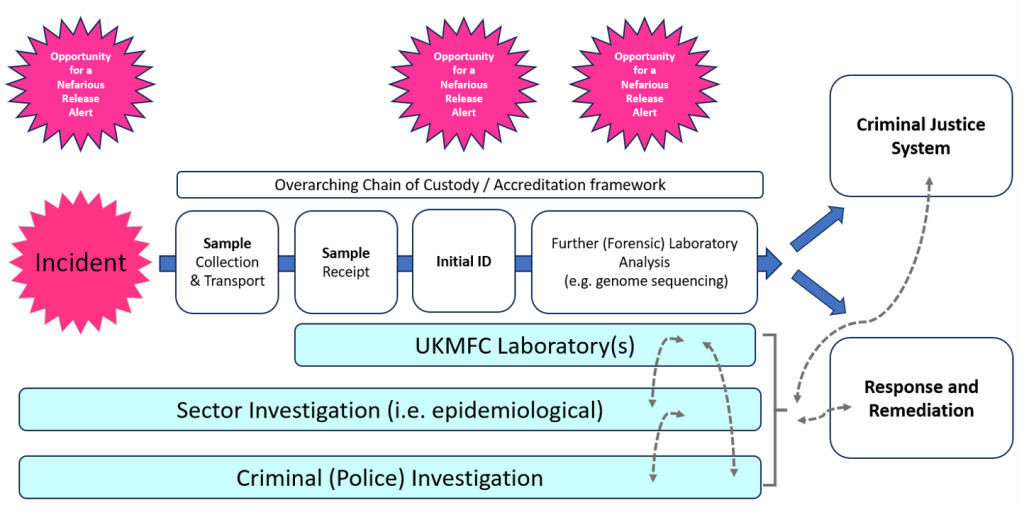
Figure 1. United Kingdom Microbial Forensics Consortium (UKMFC) investigational process, along with stages at which a nefarious release alert might be generated, and related investigations and outputs
To this end, it is clear that an overarching microbial forensic capability is strengthened if all parties within a surveillance system (and within an animal health system – this includes veterinarians and inspectors) consider whether an incident could be nefarious in a similar manner to that adopted during human disease outbreaks [10]. This can maximise the opportunity for detection of a deliberate release and ensure the early initiation of a microbial forensics investigation, as well as engagement with law enforcement and any sector-led investigation.
When considering the outputs from a microbial forensic investigation, it is important to consider how any remaining levels of uncertainty are communicated, e.g. when answering the question ‘has this organism been engineered?’. Approaches for communicating uncertainty are already utilised by the UK intelligence community [11] and this could provide the UKMFC with a framework in which to develop outputs (i.e. into a ‘probability yardstick’). This would help ensure clarity when communicating complex technical information, reduce misinterpretations and facilitate informed decision-making.
Addressing uncertainty is also important when identifying other investigatory bodies that might provide information pertinent to a microbial forensics investigation.
Making Progress Through Outreach
The development of the UKMFC [12] has involved a significant amount of outreach in a conscious effort to highlight this new capability as a deterrent to the misuse of biological materials. One benefit of this open approach is awareness of, and collaboration with, synergistic biosurveillance activities both within the UK and internationally. In the future, this may, for example, allow integration of UKMFC bioinformatic pipelines directly into metagenomic-based biosurveillance activities [13] to provide a near-real-time microbial forensic alert system.
Whilst the UKMFC is positioned as a new wet-lab capability, as mentioned above and in Figure 1, other investigations (i.e. animal health and criminal investigations) would also be ongoing during an incident. Information not necessarily accessible to UKMFC labs (i.e. epidemiological data or wider contextual information) could provide valuable insights into an overarching assessment of whether an incident is naturally occurring, accidental or deliberate in origin. This combined analysis would move any probability-yardstick-based assessment to a higher confidence level, enabling better decision-making during a response stage. To facilitate this, the authors have actively built links across the UK biosurveillance, law enforcement and intelligence communities as a step towards improved coordination of activities.
The UKMFC adds a new layer to the UK’s alert system for identifying the misuse of biological materials. Our Team-of-Teams approach [14], with transparent information sharing between interconnected teams and units (e.g. BWG, FWG, different laboratories, DASA competition suppliers), has enabled rapid, cross-sector collaboration against unified objectives. This ethos has been central to our progress and, whilst all countries may have different models, the authors would welcome the opportunity to exchange ideas and experience with any nation developing similar capabilities.
(𝖺) 𝖳𝗁𝖾 𝗐𝗈𝗋𝖽 ‘𝗂𝗇𝖽𝗎𝗌𝗍𝗋𝗒’ 𝗂𝗌 𝗎𝗌𝖾𝖽 𝗁𝖾𝗋𝖾 𝖺𝗌 𝖺 𝗀𝖾𝗇𝖾𝗋𝗂𝖼 𝗍𝖾𝗋𝗆 𝗍𝗈 𝗂𝗇𝖼𝗅𝗎𝖽𝖾 𝗇𝗈𝗇-𝖺𝖼𝖺𝖽𝖾𝗆𝗂𝖼 𝗅𝗂𝗆𝗂𝗍𝖾𝖽 𝖼𝗈𝗆𝗉𝖺𝗇𝗂𝖾𝗌 (𝗂.𝖾. 𝗇𝗈𝗍 𝗎𝗇𝗂𝗏𝖾𝗋𝗌𝗂𝗍𝗂𝖾𝗌) 𝗍𝗁𝖺𝗍 𝖺𝗋𝖾 𝖺𝖻𝗅𝖾 𝗍𝗈 𝗉𝗋𝗈𝗏𝗂𝖽𝖾 𝖺 𝗌𝖾𝗋𝗏𝗂𝖼𝖾/𝗍𝖾𝖼𝗁𝗇𝗈𝗅𝗈𝗀𝗒 𝖽𝖾𝗏𝖾𝗅𝗈𝗉𝗆𝖾𝗇𝗍 𝖺𝗀𝖺𝗂𝗇𝗌𝗍 𝗍𝗁𝖾 𝖺𝗂𝗆𝗌 𝗈𝖿 𝗍𝗁𝖾 𝖣𝖾𝖿𝖾𝗇𝖼𝖾 𝖺𝗇𝖽 𝖲𝖾𝖼𝗎𝗋𝗂𝗍𝗒 𝖠𝖼𝖼𝖾𝗅𝖾𝗋𝖺𝗍𝗈𝗋 (𝖣𝖠𝖲𝖠) 𝖼𝗈𝗆𝗉𝖾𝗍𝗂𝗍𝗂𝗈𝗇.
Main image: ©Crown Copyright 2025 Dstl
Acknowledgements
The Defence Science and Technology Laboratory (DSTL) project team thanks the support and collaboration of all United Kingdom Microbial Forensics Consortium (UKMFC) laboratories and the wider United Kingdom and International Biosurveillance communities in the development of the UKMFC. The views expressed in this article may not reflect the views of the UK Ministry of Defence nor those of His Majesty’s Government.
Copyright
Crown copyright (2025), DSTL. This information is licensed under the Open Government Licence v3.0. To view this licence, visit https://www.nationalarchives.gov.uk/doc/open-government-licence/. Where we have identified any third-party copyright information, you will need to obtain permission from the copyright holders concerned. Any enquiries regarding this publication should be sent to [email protected].
References
[1] Broothaerts W, Jacchia S, Angers A, Petrillo M, Querci M, Savini C, et al. New genomic techniques: state-of-the-art review. Luxembourg (Luxembourg): Publications Office of the European Union; 2021. https://data.europa.eu/doi/10.2760/710056
[2] Rissman T, Prieto A. Attributing biological weapons use: strengthening Department of Defense capabilities to investigate deliberate biological incidents. Santa Monica (United States of America): RAND Corporation; 2024. Available at: https://www.rand.org/pubs/research_reports/RRA2360-1.html (accessed on 29 August 2025).
[3] UK Microbial Forensics Consortium. London (United Kingdom): UK Ministry of Defence; 2024. Available at: https://www.gov.uk/government/groups/uk-microbial-forensics-consortium (accessed on 29 August 2025).
[4] UK Biological Security Strategy. London (United Kingdom): UK Cabinet Office; 2023. Available at: https://www.gov.uk/government/publications/uk-biological-security-strategy (accessed on 29 August 2025).
[5] World Organisation for Animal Health (WOAH). One Health. Paris (France): WOAH; 2025. Available at: https://www.woah.org/en/what-we-do/global-initiatives/one-health/ (accessed on 29 August 2025).
[6] Future-proofing biosecurity by strengthening the UK’s microbial forensic capability: competition document. London (United Kingdom): Defence and Security Accelerator; 2025. Available at: https://www.gov.uk/government/publications/future-proofing-biosecurity-by-strengthening-the-uks-microbial-forensics-capability/future-proofing-biosecurity-by-strengthening-the-uks-microbial-forensic-capability-competition-document (accessed on 29 August 2025).
[7] Press release: National Emergency Alert test to be held on 7th September. London (United Kingdom): UK Cabinet Office; 2025. Available at: https://www.gov.uk/government/news/national-emergency-alert-test-to-be-held-on-7th-september (accessed on 29 August 2025).
[8] United Nations Office for Disarmament Affairs. Treaties Database. Convention on the Prohibition of the Development, Production and Stockpiling of Bacteriological (Biological) and Toxin Weapons and on Their Destruction. New York (United States of America): United Nations; 1972. Available at: https://treaties.unoda.org/t/bwc (accessed on 1 December 2025).
[9] Goldswain H, Penrice-Randal R, Donovan-Banfield I, Duffy CW, Dong X, Randle N, et al. SARS-CoV-2 population dynamics in immunocompetent individuals in a closed transmission chain shows genomic diversity over the course of infection. Gen. Med. 2024;16:89. https://doi.org/10.1186/s13073-024-01360-1
[10] Chemical, biological, radiological and nuclear incidents: clinical management and health protection. London (United Kingdom): Public Health England; 2018. Available at: https://assets.publishing.service.gov.uk/media/5b10120c40f0b634d14c21ed/Chemical_biological_radiological_and_nuclear_incidents_clinical_management_and_health_protection.pdf (accessed on 29 August 2025).
[11] Defence Intelligence: communicating probability. London (United Kingdom): UK Ministry of Defence; 2023. Available at: https://www.gov.uk/government/news/defence-intelligence-communicating-probability (accessed on 29 August 2025).
[12] UK Biological Security Strategy Implementation Report June 2023–June 2025. London (United Kingdom): UK Cabinet Office; 2025. Available at: https://www.gov.uk/government/publications/uk-biological-security-strategy-implementation-report-june-2023-june-2025/uk-biological-security-strategy-implementation-report-june-2023-june-2025-html (accessed on 29 August 2025).
[13] News story: UKHSA launches new metagenomic surveillance for health security. London (United Kingdom): UK Health Security Agency; 2025. Available at: https://www.gov.uk/government/news/ukhsa-launches-new-metagenomic-surveillance-for-health-security (accessed on 29 August 2025).
[14] McChrystal GS, Silverman D, Collins T, Fussell C. Team of teams: new rules of engagement for a complex world. London (United Kingdom): Penguin; 2015.
Continue reading



Receive the latest updates from our Organisation, network, and partners.
This includes Members’ self-declarations, news articles, scientific insights, publications, and more.